How Lumenci cut patent mining time and cost by 60% across a global telecom portfolio
Large portfolios usually get split across vendors by technology, and every handoff costs time.
Running 4G, 5G, codecs, and machine learning through one team cut mining time and cost by 60%.
.webp "Feature images - 2026-05-07T163421.509 (convert.io)")
Case at a Glance
Domain
Service
Client
Outcome
Patent mining time and cost down 60%, across a portfolio spanning four technology domains.
If This Sounds Like Your Case
The portfolio spans several technology domains, so no single vendor covers all of it
Mining and charting costs scale with portfolio size, and the economics are getting difficult
Claim charts have to be good enough for a buyer or a court, not just for internal triage
Quality varies between vendors, and every new engagement starts with re-explaining the portfolio
Four technology domains usually means four vendors, four onboardings, and four teams who never see the whole portfolio.
What most teams do.
What Lumenci did instead.
Ran the whole programme as the sole technical partner, across telecom, 4G, 5G, video codecs and machine learning.
Why it mattered.
How It Was Done
Lumenci ran the programme as the client's sole technical partner, staffed with industry and 5G experts, codec specialists, and analysts who know what a claim chart has to survive when it reaches a buyer or a court.
Assets were assessed across the full portfolio to identify the patents with real monetization potential, using testing and mining methods refined as the programme ran.
Detailed charts were prepared with industry and 5G experts, built to the standard a buyer or an enforcement action requires rather than to an internal review standard
Standard essential patent positions were tested against exhaustive prior art searches, so essentiality claims rested on analysis rather than assertion.
Testing was carried out across telecom, wireless, and machine learning implementations to establish how the claimed technologies appear in practice.
The same team and the same standards ran across a high volume of assets over a long-running programme, so output quality did not vary by batch
What Changed for the Client
Where they stood.
One technical partner across every domain in the portfolio, delivering charts to a consistent standard
What it forced.
Licensing and enforcement decisions could move on charted evidence rather than waiting on the next vendor engagement to produce it
Where it stands.
A sustained monetization programme running across multiple technology domains, with mining time and cost down 60%
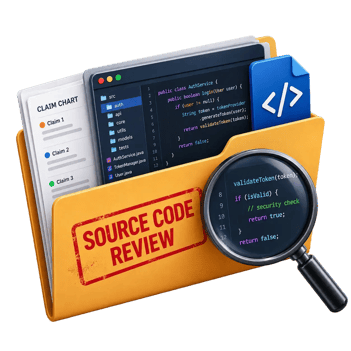
Source Code Review for Patent Litigation

100k+ Patents Analyzed
5,000+ Claim Charts Delivered
250+ Litigations Supported
What This Would Look Like for Your Matter
A scoping conversation covers the portfolio, the domains it spans, what mining has already been done, and whether the output needs to support licensing outreach, a sale, or enforcement. You get a view of what the portfolio can carry before committing to a full programme.
Frequently Asked Questions
What does patent mining actually involve?
Working through a portfolio to identify which assets have monetization potential, which means establishing what technologies are being implemented in the market and which patents read on them cleanly enough to assert or license.
Why is patent mining expensive at portfolio scale?
Because cost scales with asset count, and most of the spend goes on assets that turn out to be unmonetizable. Reducing that means getting better at eliminating weak assets early, which is a methodology question rather than a headcount one.
Can one technical partner cover telecom, codecs, and machine learning?
It requires genuine depth in each domain rather than generalists. Where it works, the advantage is that methods and portfolio knowledge carry across domains instead of being rebuilt with every new engagement.
What makes a claim chart enforcement-ready rather than just internal?
Traceability. Every limitation has to map to evidence a counterparty can check and dispute, which is a higher standard than a chart built to help an internal team decide what to look at next.
How is SEP essentiality tested?
By reading the claims against the standard itself and then against prior art, since an essentiality position that has not been tested against prior art is a claim rather than an analysis. Lumenci provides SEP and standards analysis as a standalone engagement.
Can Lumenci support enforcement once monetization moves to litigation?
Yes. The charting and testing work that supports licensing is the same technical record an enforcement action rests on, which is why the two sit inside one IP litigation support practice.